A continuous and Comprehensive GUIDE on AIM TRAINING
Introduction
Aim training is the deliberate practice* of improving one’s ability to aim with precision, speed, and control, that can be transfered in shooting games. It focuses on isolating the mechanical aspects of performance — such as flicking, tracking, target switching, and click timing — and refining them through structured, feedback-driven routines.
Unlike casual gameplay, aim training emphasizes consistency and intentional repetition. Each session is designed to help players build stable muscle memory, enhance visual-motor coordination, and improve reaction time through measurable progression.
At its core, aim training is not just about hitting targets — it’s about developing the underlying neuromuscular and perceptual systems that allow a player to perform reliably under pressure. Over time, this transforms, aiming from a conscious effort into an automatic skill, ( also called the 2nd self by Tim Gallwey), through proper repetition on form, leaving more cognitive space for conscious processing during gameplay, and planning higher-level strategy and decision-making in-game.
MYELIN : The Bio-benefits of training. (the key to learning skills)
When you practice aiming, you’re not only training your hands and eyes — you’re training your nervous system.
Every repetition you perform sends tiny electrical signals through neural pathways responsible for movement and perception. The more often these signals travel along the same route, the more your body reinforces that pathway with a substance called myelin.
Myelin acts as insulation around your neural circuits. The thicker the myelin sheath becomes, the faster and more accurately your signals can travel. In other words, myelin is what turns effort into skill.
Through deliberate, precise aim training, you’re essentially “wiring” your brain and body to execute micro-movements with less resistance and greater speed.
However, myelin responds best to focused, error-corrected practice — not to mindless repetition. If you train with poor form, you’re reinforcing inefficiency; if you train with awareness and control, you’re reinforcing excellence. Over time, well-insulated neural pathways allow your aiming motions to become smooth, automatic, and consistent even under pressure.
MOUSE SENSITIVITY
Why sensitivity matters and we should get familiar with it?
To make things simpler, Voltaic staff put together a very useful chart. It categorizes the optimal sensitivity relative to games genre. This stops us from blindly finding our sensitivity match.
As a starting point, this will simplify getting an approximate range based on your favorite or main games. It will also remove a ton of experimentation time.
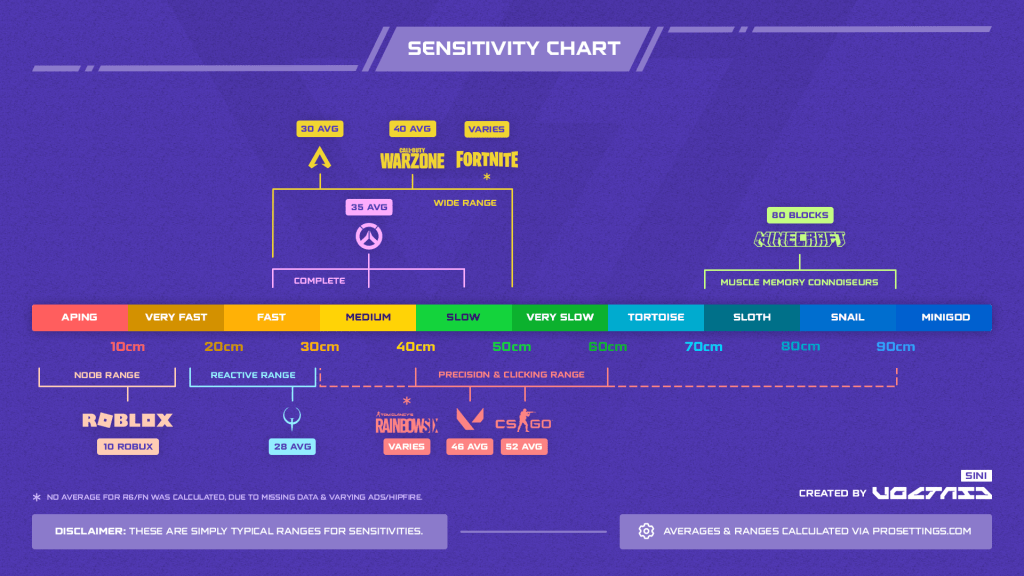
As example, VALORANT sensitivity is in the slow range, as recommended by the chart, close to Tortoise, mainly because Crosshair Placement in much more important for the TacFps genre. ( adding and talking about Pro settings maybe )
I use the chart to set and adjust my sensitivity based on the gameplay mechanics of each games.
Another Very useful tool is the sensitivity converter from Kovaaks website. If you are playing multiple titles within the same genre, it can be useful to keep a similar range. But sometimes the metrics can vary between games and engines. The sensitivity converter can convert the values and maintain a similar edpi for every games.

BASIC MOUSE SETTINGS & TERMINOLOGY
Before starting our journey, let’s get acquainted with our tools, settings and termonology of the field.
The mouse :
- Windows Enhance pointer precision : ( windows built in mouse acceleration ).
- DPI : Dot Per Inch is how fast the cursor moves on screen from your hand movement. The higher the value the faster the cursor will move to the physical hand movement.
- EDPI : Dot per inch × In-game mouse sensitivity.
360/cm : real life cm swipe on mouse pad relative to 360 degree turn in game.
My settings :
- Razer v3 pro
- Dpi : 1600
- Edpi : 1600 x 0.1 Valorant in-game mouse sensitivity.
- 360/cm : 60cm. Very slow range if we refer to the chart.
AIM TRAINERS
AimLabs
Kovaaks
Oblivity
3dAimTrainer
AIM TRAINING PLAYLIST
The net is filled with custom playlists and it can be overwhelming at times know what to get started with. In this article we will be highlighting the most popular groups, both created by pioneers of aim trainers amd more recent ones.
Voltaic S5
Official Voltaic Season 5 – Novice Benchmark Playlist.
A well balance benchmark to evaluate general skills on clicking, tracking and switching.

The Kovaaks playlist Code is: KovaaKsBouncingSilverBinding
https://kovaaks.com/kovaaks/playlists?search=KovaaKsBouncingSilverBinding
https://evxl.app/groups/voltaic
KovaaKsSnipingHardCamp

The official Voltaic Valorant “RAMP” Warm-up Playlist. Created by VT MINIGOD

Luckilly a few pioneers of in the aim community (minigod, MattyOW, BardOz, ) have narrowed down scenarios and playlists targeted to both specific games and specific skills.
Let’s take a quick look at what are the different categories that exist and what it trains the most.
🖱 CONTROL TRACKING
Goal :
Perfect micro-adjustments — small, controlled reactions to target strafes that keep your aim synchronized with target movement.
Control tracking involves smooth yet elusive target motion — not linear, not purely reactive.
It’s the opposite of raw smoothness and pure reactivity.
- Perfecting micro-adjustments .

- Develop faster and smoother micro-corrections.
- Build better target reading and tension management.
- Smooth yet elusive target motion.
- Increase total time on target.
KovaaKsPushingMauveWeaponlevel
Viscose Benchmark is mostly targeted towards Tracking.

Just like games genre, aim training scenarios are best played within specific sensitivity range. As a good student, I try track the sensitivity of the best aimers first, then adjust it to my skill level.
- WhisphereRawControl : Percentile 87.5
- VT Matty : 46cm/360. https://www.youtube.com/watch?v=gXUO9gLr5hg (Stare at who you want to become _ The little book of Talent Code).
- Viscose : 39cm/360.
- Jo3ast : 43cm/360.
- Whisphere : Percentile 84.9
- VT Matty : 29cm/360. https://www.youtube.com/watch?v=p6njMQBPkIg
- Viscose : 34cm/360. https://www.youtube.com/watch?v=_624grv7tsk
- Jo3ast : 34cm/360. (new higher score)
- SmoothBot Invincible Goated : Percentile 87.1
- VT Matty : 36cm/360.
- Viscose : 35cm/360.
- Jo3ast : 34cm/360.
- Leaptrack Goated 75% Slightly Larger : Percentile 69.5
- Viscose : 38cm/360.
- Jo3ast : 46cm/360.
- Controlsphere rAim Easy : Percentile 87.1
- Viscose : 43cm/360.
- VT Controlsphere Novice S5 Hard : Percentile 82.4
- Viscose : 48cm/360.
- Air Angelic 4 Voltaic Easy : Percentile 89.7
- Viscose : 31cm/360. (higher score).
- VT Matty : 51cm/360.
- Jo3ast : 31cm/360. (new high score)
- CloverRawControl Easy : Percentile 78.2
- Viscose : 39cm/360.
- VT Matty : 51cm/360.
- Jo3ast : 46cm/360.
- Controlsphere Far Larger : Percentile 62.7
- Viscose : 39cm/360.
- VT Matty : 46cm/360.
- PGTI Voltaic Easy : Percentile 81.1
- Viscose : ?/360.
- VT Matty : ?/360.
- Jo3ast : ?/360.
- Air CELESTIAL No UFO Easy : Percentile 41
- Viscose : ?/360.
- VT Matty : 28/360.
- Jo3ast : ?/360.
- Whisphere Small & Slow 75% : Percentile 39
- Viscose : ?/360.
- VT Matty : ?/360.
- Jo3ast : ?/360.
GLOSSARY
Deliberate practice : Also called deep practice: The form of learning marked by :
- 1 __The willingness to operate on the edge of your ability, ( frustration, pain, struggles ) aiming for targets that are just out of reach.
- 2 __ To embrace in attentive repetition.
Not only aim but reading skills and reflexes.





 Skill Acquisition Journey through Competitive Gaming
Leave a comment